


Multiple sclerosis: Difference between revisions
ClaireLewis (talk | contribs) |
ClaireLewis (talk | contribs) No edit summary |
||
| Line 17: | Line 17: | ||
*Symptoms worsen with increases in body temperature, classically after hot showers (Uhthoff's phenomenon<ref>Flensner G, et al. "Sensitivity to heat in MS patients: a factor strongly influencing symptomology-an explorative survey". BMC Neurol. 2011. 11:27.</ref>) | *Symptoms worsen with increases in body temperature, classically after hot showers (Uhthoff's phenomenon<ref>Flensner G, et al. "Sensitivity to heat in MS patients: a factor strongly influencing symptomology-an explorative survey". BMC Neurol. 2011. 11:27.</ref>) | ||
*Muscle/sensory signs: | *Muscle/sensory signs: | ||
**Lower extremity weakness usually worse than upper extremity | **Lower extremity [[weakness]] usually worse than upper extremity | ||
**Upper motor neuron signs: | **Upper motor neuron signs: | ||
***Hyperreflexia | ***Hyperreflexia | ||
***Positive Babinski | ***Positive Babinski | ||
**Decrease in proprioception / pain/temperature sensation | **[[numbness|Decrease]] in proprioception / pain/temperature sensation | ||
**Lhermitte sign | **Lhermitte sign | ||
***Electric shock sensation radiating down back into arms/egs from neck flexion | ***Electric shock sensation radiating down back into arms/egs from neck flexion | ||
| Line 27: | Line 27: | ||
*[[Optic neuritis]] | *[[Optic neuritis]] | ||
**Initial sign in 30% of patients | **Initial sign in 30% of patients | ||
**Vision loss (usually unilateral) often preceded by retrobulbar pain | **[[Vision loss]] (usually unilateral) often preceded by retrobulbar pain | ||
**Blurred vision | **[[Blurred vision]] | ||
**Afferent pupillary defect is pathognomonic for optic neuritis | **Afferent pupillary defect is pathognomonic for optic neuritis | ||
** | **[[Nystagmus]] | ||
**[[Diplopia]] | **[[Diplopia]] | ||
*Internuclear ophthalmoplegia | *[[Internuclear ophthalmoplegia]] | ||
**Abnormal eye adduction bilaterally and horizontal nystagmus | **Abnormal eye adduction bilaterally and horizontal nystagmus | ||
**Convergence (both eyes center medially) is preserved | **Convergence (both eyes center medially) is preserved | ||
| Line 44: | Line 44: | ||
==Evaluation== | ==Evaluation== | ||
*[[LP|CSF]] | |||
*[[LP | |||
**Elevated protein and gamma-globulin (increased oligoclonal bands) | **Elevated protein and gamma-globulin (increased oligoclonal bands) | ||
*[[brain MRI|MRI]] | *[[brain MRI|MRI]] | ||
| Line 67: | Line 52: | ||
File:MS_MRI_2.jpg|MRI brain with contrast of same patient with new onset MS with another lesion in the left cerebellum. | File:MS_MRI_2.jpg|MRI brain with contrast of same patient with new onset MS with another lesion in the left cerebellum. | ||
</gallery> | </gallery> | ||
*[[brain MRI|MRI]] with GAD of brain (+/- spine) | |||
*CBC, Chemistry | |||
*[[Urinalysis]] | |||
==Management== | ==Management== | ||
Revision as of 04:03, 3 October 2019
Background
- CNS myelin destruction causes variable motor, sensory, visual and cerebellar dysfunction
Types
- Relapsing/remitting (most common)
- Relapse (days-months) followed by remission
- Secondary progressive
- Relapses and partial recoveries occur, but disability does not fade away between cycles
- Primary progressive
- Symptoms progress slowly and steadily without remission
- Progressive relapsing
- Similar to primary progressive but with superimposed flares
Clinical Features
- Classic patient has multiple presentations for neuro symptoms of different areas of pathology
- Patient often has resolution of the earlier symptoms
- Symptoms worsen with increases in body temperature, classically after hot showers (Uhthoff's phenomenon[1])
- Muscle/sensory signs:
- Lower extremity weakness usually worse than upper extremity
- Upper motor neuron signs:
- Hyperreflexia
- Positive Babinski
- Decrease in proprioception / pain/temperature sensation
- Lhermitte sign
- Electric shock sensation radiating down back into arms/egs from neck flexion
- If the discomfort is severe, carbamazepine or gabapentin may be beneficial for some patients.
- Optic neuritis
- Initial sign in 30% of patients
- Vision loss (usually unilateral) often preceded by retrobulbar pain
- Blurred vision
- Afferent pupillary defect is pathognomonic for optic neuritis
- Nystagmus
- Diplopia
- Internuclear ophthalmoplegia
- Abnormal eye adduction bilaterally and horizontal nystagmus
- Convergence (both eyes center medially) is preserved
- Dysautonomia
- Urinary retention (increased risk of UTI/pyelo)
- Constipation or incontinence
- Sexual dysfunction (males)
Differential Diagnosis
Weakness
- Neuromuscular weakness
- Upper motor neuron:
- CVA
- Hemorrhagic stroke
- Multiple sclerosis
- Amyotrophic Lateral Sclerosis (ALS) (upper and lower motor neuron)
- Lower motor neuron:
- Spinal and bulbar muscular atrophy (Kennedy's syndrome)
- Spinal cord disease:
- Infection (Epidural abscess)
- Infarction/ischemia
- Trauma (Spinal Cord Syndromes)
- Inflammation (Transverse Myelitis)
- Degenerative (Spinal muscular atrophy)
- Tumor
- Peripheral nerve disease:
- Neuromuscular junction disease:
- Muscle disease:
- Rhabdomyolysis
- Dermatomyositis
- Polymyositis
- Alcoholic myopathy
- Upper motor neuron:
- Non-neuromuscular weakness
- Can't miss diagnoses:
- ACS
- Arrhythmia/Syncope
- Severe infection/Sepsis
- Hypoglycemia
- Periodic paralysis (electrolyte disturbance, K, Mg, Ca)
- Respiratory failure
- Emergent Diagnoses:
- Symptomatic Anemia
- Severe dehydration
- Hypothyroidism
- Polypharmacy
- Malignancy
- Aortic disease - occlusion, stenosis, dissection
- Other causes of weakness and paralysis
- Acute intermittent porphyria (ascending weakness)
- Can't miss diagnoses:
Evaluation
- CSF
- Elevated protein and gamma-globulin (increased oligoclonal bands)
- MRI
- Multiple lesions in supratentorial white matter, paraventricular area, spinal cord
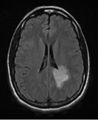
MRI brain with contrast of a patient in her mid-20s with new onset MS. Large lesion in left parietal area.
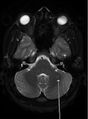
MRI brain with contrast of same patient with new onset MS with another lesion in the left cerebellum.


- MRI with GAD of brain (+/- spine)
- CBC, Chemistry
- Urinalysis
Management
- Fever must be reduced to minimize weakness associated with elevated temperature
- Antibiotics for UTI/pyelo
- High-dose steroid therapy for relapses
- Suppression therapies
- IFN B, Glatiramer, Estriol (usually not in ED)
Disposition
- Hospitalization indicated for:
- Any disease exacerbation associated with significant morbidity
- IV antibiotics or steroid therapy required
- Depression and significant risk of suicide
See Also
References
- ↑ Flensner G, et al. "Sensitivity to heat in MS patients: a factor strongly influencing symptomology-an explorative survey". BMC Neurol. 2011. 11:27.